
Payment fraud, before the wire goes out and after it already has.
Most of it starts with an ordinary email: a vendor with new bank details, an invoice that is almost right, a boss in a hurry. The FBI calls it business email compromise. We help you close the gaps before it lands. When it already has, we work out how it happened, fix it, and provide our findings to law enforcement.
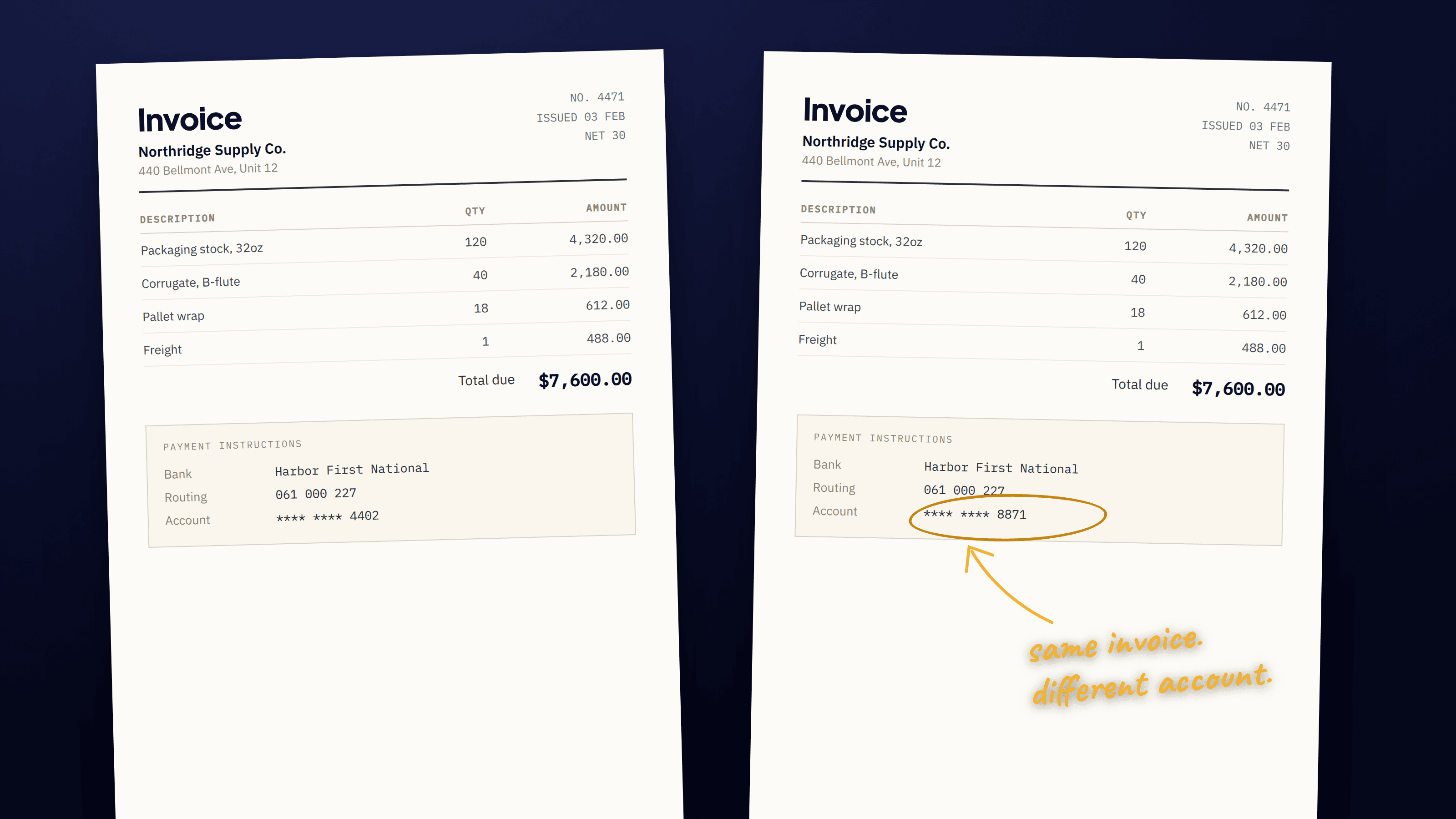
How it got through, and making sure it can’t again.
Three steps, each with a fixed fee agreed before the work starts.
How it happened
We trace the path the fraud took through your business: the email, the mailbox, the approval, the payment. The goal is not who did it. The goal is how it got through.
What to fix
A plain-language findings report. What failed, why it failed, and the specific changes that would have stopped it, in priority order.
Fixing it
We put the fixes in place with you. Mailbox and sign-in protections, a separate inbox for vendor invoices, and a callback step before any bank detail changes.
Who does what.
Finding and charging the people behind it is law enforcement’s job. Report it right away to the FBI at ic3.gov and to your local agency, and call your bank. The sooner it is reported, the more options the banks have.
Our work answers a different question: how your business was reached, and what has to change. Our findings are written to be useful to an investigator, and we provide them to law enforcement.
A risk review for the people who approve the payments.
Two to four hours, on-site or virtual, for owners and executives without a security department to lean on. You leave with three things you can hand to your team, your insurer, or your board the next day.
A clear read on real risk
We focus on the ways businesses your size actually get hit, the exposure you carry, and what those incidents look like when they land. No abstract threat models, no enterprise-tier scare slides.
Controls that pull their weight
No enterprise bloat. The few protections that make the biggest difference at your size: logins, email, backups, vendors, and basic incident prep. And which expensive things you don't actually need.
A 90-day plan you can hand off
A short, realistic checklist with clear owners and priorities. Fits around real work. Designed so it doesn't quietly become another full-time job.
What we work through.
Tailored to your business and industry. Every review pulls 4–6 of these threads based on what’s most relevant to you.
- How small businesses actually get breached in 2026
- Why email and logins are the usual starting point
- Wire-fraud and voice-clone playbooks targeting controllers and AP
- Vendor and supply-chain compromise patterns
- What protections are worth paying for, and which aren't
- What to do in the first 24 hours after an incident
- What to fix in the next 90 days
- How to talk to your insurer, IT vendor, and board about cyber risk
The boring details.
- A fixed fee for each step or review, agreed before work starts. No hourly billing, no long-term contracts.
- Reviews on-site (preferred) or virtual. Built to fit around your day, not take it over.
- Review: slides, a short summary, and a 90-day checklist. Response: a findings report and the fixes in place.
- Reviews work best with 4–25 people in the room. Larger groups on request.
- Everything is treated as confidential. Anonymized in any future writing.
- Send a note and you'll usually hear back within one business day.

Active law-enforcement cyber-fraud supervisor. 10+ years investigating the patterns covered in this training.
Tell us what happened, or what you’re worried about.
One reply within a business day. If money has already moved, say so in the first line and report it to your bank and to ic3.gov while you wait.
Where this fits
- 01 · Before it arrives
- 02 · At the inbox
- 03 · On the phone at home
- 04 · When it gets throughStop payment fraudYou are here
- 05 · Leading the response